
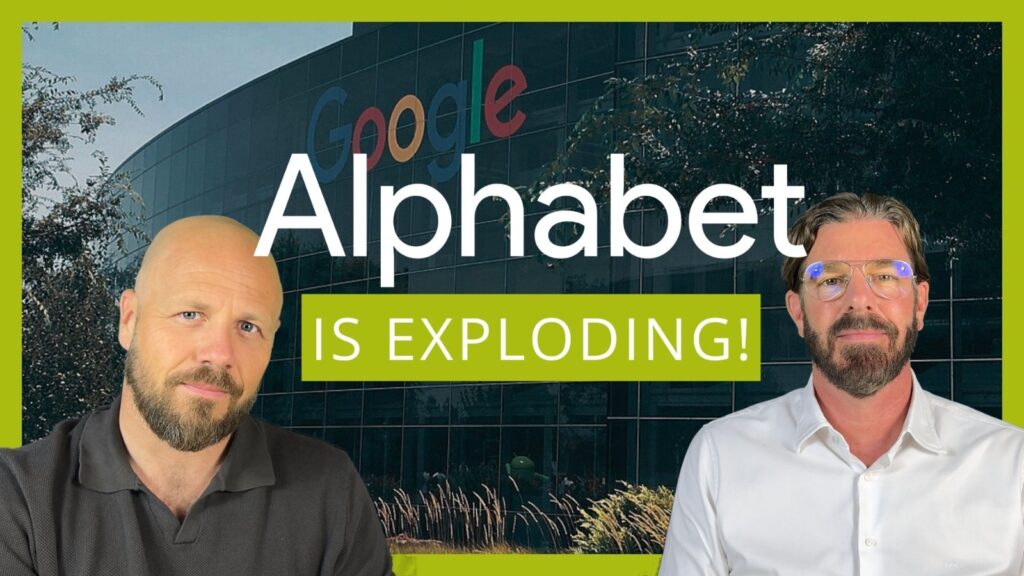
Google Is Betting Big on AI Infrastructure, But is the Demand There?
For years, investors have understood Alphabet (Google’s parent company) mainly through Google Search, YouTube, and digital advertising. That is understandable. These businesses still generate enormous revenue, cash flow, and profitability.
But the investment case for Alphabet (available to trade on our platforms under ticker GOOGL:xnas) is changing. The company is now spending extraordinary amounts on artificial intelligence (AI) infrastructure. At first glance, that may worry investors. Big technology companies are pouring hundreds of billions of dollars into AI data centers, chips, models, and cloud capacity. The obvious questions investors ask are: is the demand really there? And will they earn that money back?
In Alphabet’s case, the answer may be more encouraging than the market appreciates. Based on Alphabet’s first-quarter 2026 results and investor commentary, the company is not simply spending money in the hope that demand appears later. In many areas, demand is already there.
Alphabet’s Core Business Is Still Very Strong
Alphabet reported revenue of $109.9 billion for the first quarter of 2026, an increase of 22% year-on-year. Google Services revenue rose 16% to $89.6 billion, with Google Search & other growing 19%, YouTube advertising up 11%, and subscriptions, platforms and devices also growing 19%.
That matters because it shows the core business is not yet being visibly cannibalised by AI.
There is a valid long-term concern that AI assistants could change how people search for information online. If users move from traditional search results to AI-generated answers, advertising models may evolve. However, Alphabet’s current numbers suggest that this shift is not yet damaging the business. Search revenue still grew strongly in Q1 2026.
This gives Alphabet something many AI-focused companies do not have: a highly profitable legacy business funding the next platform shift.
Google Cloud Is No Longer a Side Story
The more interesting development is Google Cloud. Google Cloud revenue grew 63% year-on-year to $20.0 billion in Q1 2026. The segment’s operating income also reached $6.6 billion, with the operating margin rising to 32.9%, compared with 17.8% a year earlier.
That is a major change. For years, Google Cloud was seen as the third player behind Amazon Web Services and Microsoft Azure. It was strategically important, but not always central to the investment case. That is becoming harder to argue.
AI appears to be accelerating Google Cloud’s relevance. Alphabet said the largest contributor to Cloud growth in the quarter was AI solutions, supported by demand for Gemini models, AI infrastructure, TPUs, GPUs, cybersecurity, data analytics, and core GCP services.
In other words, Google Cloud is no longer just selling storage and compute. It is increasingly selling the infrastructure layer of enterprise AI.
The Backlog Is the Key Number
The most striking number is not only revenue. It is backlog. Google Cloud’s backlog nearly doubled sequentially to $462 billion by the end of Q1 2026. Alphabet expects to recognise just over 50% of that backlog as revenue over the next 24 months.
That changes how investors should think about Alphabet’s enormous capital expenditure.
If a company spends aggressively without committed demand, investors are right to be cautious. But if a company has signed demand and lacks enough capacity to serve it, the capital expenditure looks different. It becomes less like speculative spending and more like building the factory after the orders have already arrived.
Alphabet is effectively saying: demand is exceeding available supply, and we need to invest to capture it. That is a very different story from a company burning capital while still trying to prove its market.
The AI-mania in the market has also led us to cautiously ask: is AI a bubble? In this article we compare AI vs dot-com bubble, and explain valuation and investment risks, and outlines what investors should watch.
Why Alphabet’s AI Position Is Different
Alphabet’s advantage is not just that it has AI products. It is that it owns much of the AI stack.
The company has:
- Its own chips: Google has developed its own Tensor Processing Units (TPUs), designed specifically for AI workloads. Reuters reported that Alphabet is now also selling TPUs directly to some customers, expanding their commercial role beyond internal use and cloud leasing.
- Its own models: Gemini is being integrated across consumer and enterprise products. Alphabet said its first-party models are processing more than 16 billion tokens per minute via direct API use by customers, up 60% from the previous quarter.
- Its own cloud platform: Google Cloud is now benefiting directly from enterprise AI demand.
- Its own distribution: Search, YouTube, Android, Chrome, Gmail, Maps, Workspace, and Google One give Alphabet a product footprint that very few companies can match.
- Its own security layer: Cybersecurity is becoming increasingly important as companies move sensitive workloads into AI-enabled cloud environments. Alphabet’s acquisition of Wiz, which closed in March 2026, strengthens Google Cloud’s security offering.
This is the real investment opportunity. Alphabet is not just participating in AI at one level. It is present across chips, infrastructure, models, software, consumer products, enterprise cloud, and security. This integrated position is difficult to replicate by pure AI companies.
We mentioned Google’s role in cybersecurity, an increasingly relevant necessity for companies and individuals alike. If you are interested in investing in this theme, we recommend you read our article exploring the importance of cybersecurity, and the opportunities for investors to profit.
The Spending Is Huge, But So Is the Cash Generation
Alphabet’s capital expenditure is enormous. In Q1 2026 alone, capital expenditure was $35.7 billion, with most of it going into technical infrastructure for AI. Alphabet also raised its full-year 2026 capex guidance to $180 billion to $190 billion.
That is a massive number. But Alphabet also generated $174.4 billion in operating cash flow over the trailing twelve months, and $64.4 billion in trailing twelve-month free cash flow after purchases of property and equipment.
The distinction is important. Alphabet is spending heavily, but it is doing so from a position of financial strength. This is not an AI startup company relying on external capital markets to survive. It is one of the biggest and most cash-generating businesses in the world, and choosing to reinvest aggressively into an area where it already sees major customer demand.
Valuation: Not Cheap, But Not Extreme Relative to the Opportunity
As of 24 June 2026, Alphabet’s Class A shares were trading around $346, with a market capitalisation of roughly $4.19 trillion and a trailing P/E ratio of about 26.4. That is not a bargain-basement valuation. Investors are already paying for quality and growth.
However, compared with many AI-related companies that trade on far more speculative assumptions, Alphabet remains unusual. It has a dominant core business, accelerating cloud growth, deep AI infrastructure, significant cash generation, and a large signed backlog.
The market is not being asked to value only a story. It is valuing a business that is already producing substantial revenue and profit.
If you are interested in investing in future-looking technologies with huge growth opportunities, we recommend you also see our article on AI Robots: Why Elon Musk Believes This Will Be His Biggest Product Ever
The Main Risks
There are still real risks.
First, AI infrastructure is capital intensive. Higher data center spending, depreciation, and energy costs can pressure margins. Alphabet itself warned that increased technical infrastructure investment will continue to affect the profit and loss statement through higher depreciation and data center operating costs.
Second, Search remains the crown jewel. If AI materially changes user behaviour or weakens the economics of search advertising, Alphabet would need Cloud and other AI products to offset that pressure.
Third, competition remains fierce. Microsoft, Amazon, Meta, OpenAI, Anthropic, Nvidia, and others are all fighting for position in the AI ecosystem.
Finally, valuation matters. A great company can still be a poor investment if bought at too high a price.
Investor Takeaway
Alphabet’s AI spending should not automatically be seen as a warning sign.
The more interesting interpretation is that Alphabet is investing heavily because demand is already visible. Google Cloud’s backlog, its rapid revenue growth, the rise of Gemini usage, the commercialisation of TPUs, and the company’s full-stack AI position all point to a business that may be entering a new growth phase.
Alphabet is still an advertising giant. But it is increasingly also becoming an AI infrastructure company.
For investors, that makes the company worth watching closely. Not because it is risk-free, and not because every AI investment will pay off, but because Alphabet may be one of the few companies with the scale, cash flow, technology, distribution, and customer demand to justify the size of the AI opportunity in front of it.
Concretely, it can be seen that Alphabet is not spending because it has run out of options; it is spending because the orders are already arriving.
Open an account today to access our trading platforms. Choose from a single account, a joint account with someone else, or a corporate account for your business
Whether you are new to investing or an experienced trader; we have you covered! Hugo guides you through the platforms and explain all the tools and functionalities.
For more information we suggest you see our latest YouTube vlogs below. We post regular MarketReporters on hot topics relevant to you as an investor. If you’d like to explore this topic further, watch our video “The Cheapest Magnificent 7 Stock? Here’s What Alphabet Is Doing” (video in Dutch), where you will discover why this capital injection by Alphabet is not an alarm signal, but rather a response to explosive market demand.
If you’d like to further explore investing opportunities, feel free to contact us and schedule a visit to our office on Marbella’s Golden Mile.
We wish all investors success! Trade Saf€.

Kaspar Huijsman
Kaspar is a passionate investor known for his thorough analysis of news and market dynamics. With over 25 years of experience in the financial world, he never relies on half- truths and always prioritizes knowledge.
“An investment in knowledge pays the best interest.”
— Kaspar Huijsman
The information in this article should not be interpreted as individual investment advice. Although Hugo compiles and maintains these pages from reliable sources, Hugo cannot guarantee that the information is accurate, complete and up-to-date. Any information used from this article without prior verification or advice, is at your own risk. We advise that you only invest in products that fit your knowledge and experience and do not invest in financial instruments where you do not understand the risks.